The future of customer intake is moving from static forms toward adaptive digital journeys that combine conversation, structured data collection, document gathering, and workflow automation. Instead of asking every customer to follow the same sequence of fields and questions, these experiences can use natural-language interaction to understand what a customer is trying to accomplish and then guide them through the relevant process.
This does not mean forms are disappearing. For most business processes, structured fields, documents, validations, signatures, and integrations with systems such as Salesforce will remain essential. The change is that customers will increasingly be able to move between conversational and structured interactions within the same digital customer journey.
The result is a customer intake experience that adapts to the situation rather than forcing every customer through the same predefined path.
What is conversational customer intake?
Conversational customer intake is a way of collecting customer information through natural-language interaction as part of a broader digital process. Instead of presenting a fixed form at the beginning of the interaction, the experience can allow the customer to explain what they need, ask clarifying questions, and then collect the structured information required to complete the process.
The distinction is important. Conversational intake is not simply a chatbot answering customer questions. In a business process, the conversation needs to connect to the underlying journey.
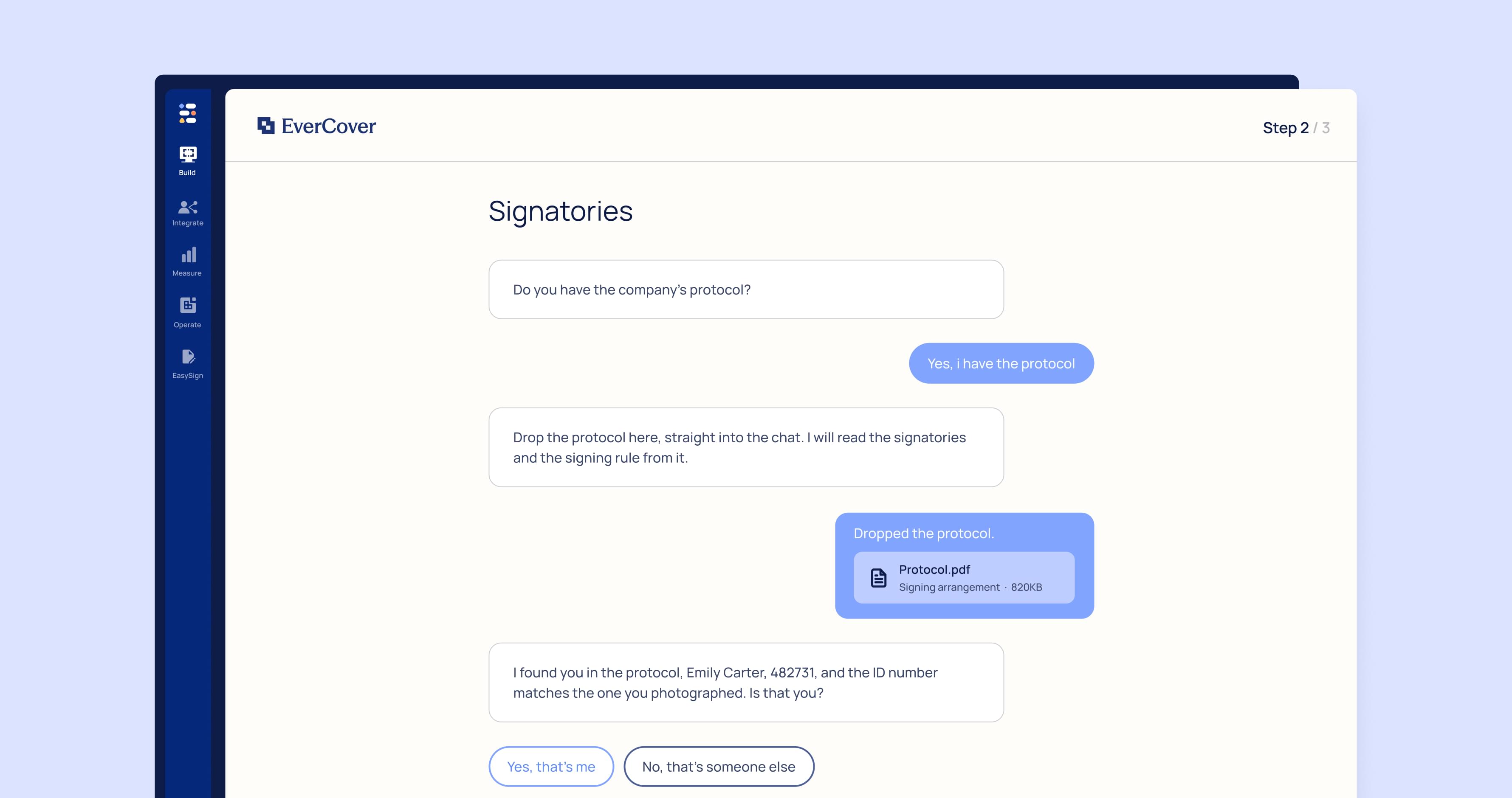
A customer might explain a request in their own words, provide additional information when asked, complete structured fields, upload documents, review the information collected, and continue to the next step without leaving the journey.
That makes conversation an interaction layer within customer intake, rather than a replacement for the entire process.
Why traditional customer intake is changing
Traditional forms are designed around what the business needs to collect. That makes sense operationally, but it can create friction when the customer's situation does not fit neatly into the structure of the form.
Consider an insurance customer who says:
“Someone hit my car yesterday and damaged the driver's side door. I have photos of the damage.”
The customer has already provided useful context. A traditional form may still require them to determine which claim category applies, answer a long sequence of questions, and navigate through fields that may or may not be relevant.
A conversational experience can use the customer's explanation as the starting point. It can clarify what happened, determine which information is needed, and then move into structured data collection.
The underlying business process has not disappeared. The customer simply does not have to understand its entire structure before they can begin.
This is particularly relevant to processes such as:
- Insurance claims and first notice of loss (FNOL)
- Policy changes and servicing
- Customer and account onboarding
- Bank and financial account opening
- Loan origination and document collection
- KYC and customer data collection
- Healthcare and patient intake
- Complex B2B onboarding
These processes have something in common: the business needs structured information, but the customer's circumstances can vary significantly.
Will conversational intake replace forms?
No. Conversational intake is more likely to complement forms than replace them.
Forms remain the better interface for many types of information. A customer entering an email address, selecting a date, providing a policy number, or uploading a document does not necessarily benefit from having a conversation first.
The more useful model combines different interaction types according to the customer's needs.
This creates a hybrid customer journey in which conversation handles context and ambiguity while structured components handle precision.
The goal is not to maximize the amount of conversation. It is to reduce unnecessary effort while still collecting the information the business needs.
How AI changes customer intake
AI introduces adaptability into processes that have traditionally been fixed.
A conventional digital journey might define a sequence such as:
- Ask a question.
- Present a form.
- Branch based on the answer.
- Request documents.
- Submit the information.
AI can add another layer by interpreting what the customer says and using that context to determine what should happen next.
For example, a customer might describe a policy change without knowing the company's terminology. Instead of asking them to select the correct category from a long list, the conversational interface can interpret the request and guide them toward the appropriate workflow.
The same principle can apply to account opening, loan applications, claims intake, onboarding, and other complex processes.
This does not eliminate business rules. In fact, the opposite is true. AI works alongside the structured logic that determines what information is required, which documents need to be collected, what validations apply, and which system should receive the resulting data.
The customer experience becomes more flexible while the underlying process remains controlled and structured.
What does a conversational customer journey look like?
A conversational customer journey combines natural-language interaction with the structured components required to complete a business process.
A typical journey could look like this:
Customer explains what they need → AI clarifies the request → relevant information is collected → structured fields appear when precision is required → documents are collected → information is validated → the appropriate business system is updated → the next step is triggered.
The important point is that the customer does not have to move between a chatbot, a form, an upload portal, and a separate workflow.
Conversation becomes part of the same digital journey.
This is where the emerging generation of customer-facing interfaces differs from traditional chatbots. A chatbot can answer a question. A conversational journey can help a customer complete a process.
Why integration matters to conversational intake
A conversational interface is only as useful as what happens to the information it collects.
If a customer explains their situation in chat but an employee still has to copy the information into Salesforce, send documents to another team, or re-enter data into a separate system, the organization has improved the front end without solving the underlying intake problem.
For conversational customer intake to create meaningful value, it needs to connect with the systems and workflows behind the customer experience.
That can include:
- CRM systems such as Salesforce
- Core banking or financial systems
- Insurance policy administration systems
- Loan origination systems
- Document management systems
- Workflow and approval processes
This is why the future of customer intake is not simply a question of whether companies should add AI chat. The more important question is whether the customer-facing experience can connect the customer's interaction to the process that needs to happen next.
From static forms to adaptive customer journeys
For years, digital intake has largely been designed around a simple assumption: the business knows the questions it needs to ask, so the customer should work through those questions.
AI changes the starting point.
Instead of beginning with every possible question, the experience can begin with the customer's intent and determine w
FAQ

Forget forms. Create digital customer journeys.