TL;DR
Insurance policy applications are often abandoned because customers encounter lengthy forms, repetitive questions, unclear requirements, document requests, and disconnected systems. Every extra step increases the likelihood that a customer will leave before completing the process.
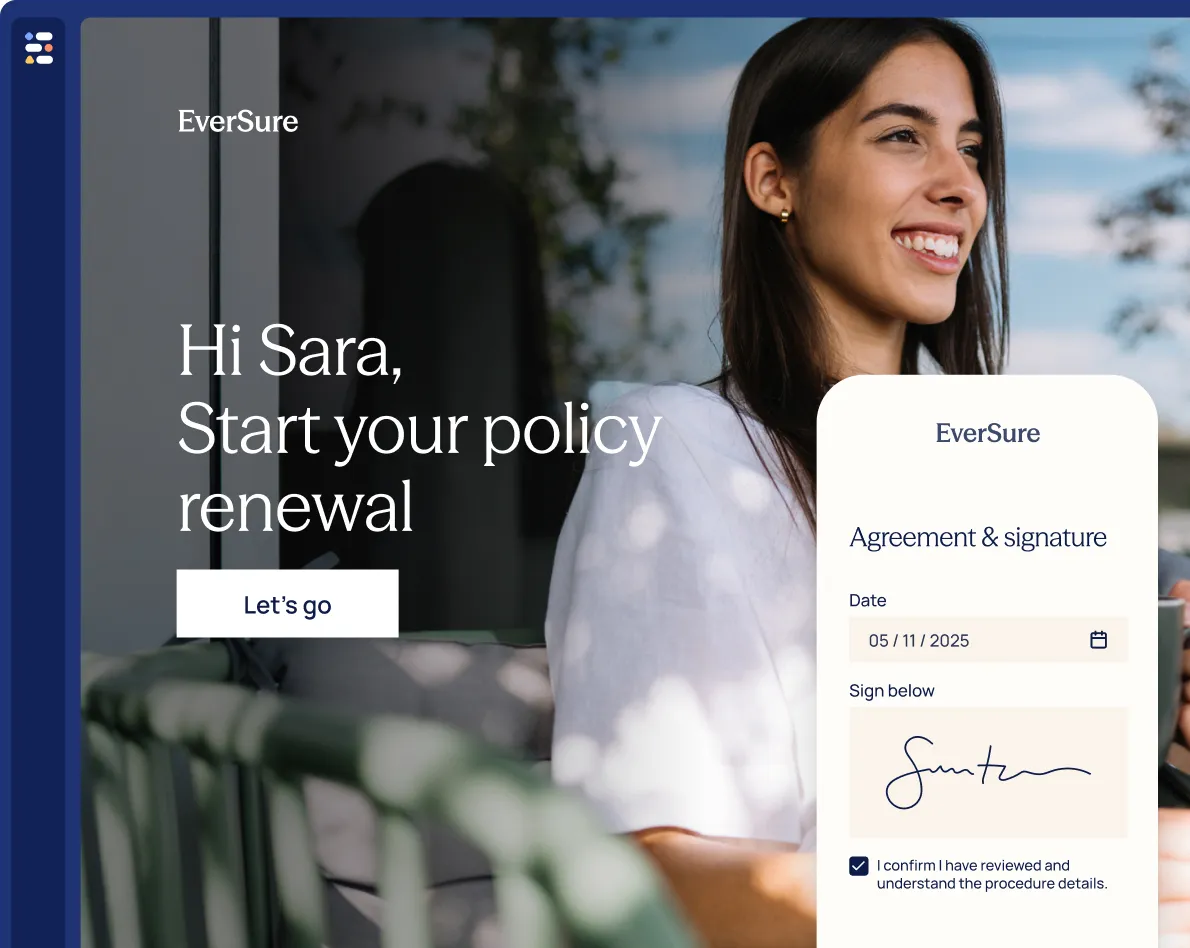
Digital customer journeys reduce policy drop-off by guiding applicants through a personalized experience with conditional logic, prefilled data, real-time validation, document uploads, automated reminders, and integrated eSignatures. Instead of simply digitizing forms, platforms like EasySend digitize the entire policy application process from quote to policy issuance. See our guide on how to reduce insurance policy drop-off rates with digital journeys for a deeper look at the specific tactics insurers can use to improve completion rates.
What is policy drop-off?
Policy drop-off (also called application abandonment) is the percentage of applicants who begin an insurance application but never complete it.
Drop-offs can happen during:
- Quote requests
- New policy applications
- Renewals
- Endorsements
- Beneficiary updates
- Underwriting questionnaires
- Payment collection
- Signature collection
For insurers, even small improvements in completion rates can translate into significant increases in premium revenue while reducing operational costs.
Why do insurance customers abandon applications?
Most policy applications were never designed for digital-first customers.
Instead of experiencing a guided interaction, customers often encounter:
- Long static forms
- PDF applications
- Requests to repeat information
- Manual document uploads through email
- Multiple phone calls
- Separate eSignature platforms
- Slow approval processes
- Little visibility into application status
The result is frustration—and abandonment.
This is part of a broader problem with insurance customer data intake. Traditional forms and PDFs often leave insurers with incomplete information, manual processing, and repetitive customer interactions. See the evolution of customer data intake in insurance for more on how insurers are moving from static forms to dynamic digital interactions.
For a more detailed overview, see the ebook Customer data intake in insurance 101: ultimate 2025 guide, which covers data collection, intake methods, best practices, and the future of customer data intake in insurance.
Common reasons policyholders drop off
1. Applications ask too many unnecessary questions
Traditional forms show every possible question regardless of the applicant.
A renter doesn't need questions about commercial property.
A single applicant doesn't need spouse information.
Digital journeys use conditional logic to display only relevant questions.
Applicants complete less work while insurers collect better data.
This approach is particularly important in complex insurance applications, where requirements vary based on the type of policy, customer profile, coverage, and underwriting needs. EasySend's article on transforming the life insurance customer journey with digital submissions explores how digital data intake can simplify life insurance submissions and reduce the back-and-forth involved in underwriting.
2. Customers must enter information multiple times
Many insurers ask applicants to repeatedly provide:
- Personal information
- Address
- Policy numbers
- Vehicle information
- Beneficiary details
This happens because disconnected systems don't share data.
Digital journeys automatically prefill known information from:
- CRM
- Policy administration systems
- Previous applications
- Customer portals
Applicants verify information instead of retyping it.
3. PDFs create unnecessary friction
Despite digital transformation initiatives, many insurers still rely on PDFs.
Customers must:
- Download documents
- Print them
- Sign manually
- Scan pages
- Upload files
- Email attachments
Each additional task increases abandonment.
Digital journeys replace PDFs with responsive, mobile-friendly experiences that work across devices.
4. Applicants don't know what documents they'll need
Nothing causes abandonment faster than discovering halfway through an application that additional documents are required.
Examples include:
- Driver's license
- Proof of address
- Vehicle registration
- Medical records
- Property photos
- Income verification
Digital journeys clearly communicate document requirements while allowing applicants to upload files during the process.
5. Validation happens too late
Applicants often discover mistakes only after submitting an application.
Examples include:
- Missing fields
- Invalid policy numbers
- Incorrect dates
- Invalid phone numbers
- Unsupported file types
Real-time validation catches problems immediately.
Customers fix issues before submission instead of restarting later.

6. Applications are not mobile friendly
Most insurance customers begin applications on mobile devices.
If they encounter:
- Tiny PDF fields
- Horizontal scrolling
- Long pages
- Difficult uploads
they often abandon the process.
Modern digital journeys are built mobile-first.
7. Customers cannot pause and return
Insurance applications often require gathering information from multiple sources.
Without Save and Continue, customers frequently abandon the process permanently.
Digital journeys allow applicants to pause and resume from any device.
How digital journeys reduce insurance policy abandonment
Unlike traditional forms, digital journeys guide applicants through an entire process.
Rather than presenting one long application, information is collected step by step.
This creates a more conversational, personalized experience.
1. Personalize every application
Different applicants require different information.
Examples include:
- Auto vs. home insurance
- Individual vs. family policies
- Personal vs. commercial insurance
- Existing vs. new customers
Conditional business logic automatically adapts the journey.
Applicants only complete what's relevant.
2. Prefill existing customer data
Returning customers should never start from scratch.
EasySend can prefill information from:
- Salesforce
- Guidewire
- Duck Creek
- Policy administration systems
- CRM platforms
- Customer portals
Reducing manual typing improves completion rates while reducing data errors.
3. Collect documents inside the journey
Instead of requesting documents later by email:
Applicants upload:
- Photos
- IDs
- Supporting documentation
- Medical reports
- Proof of ownership
- Financial statements
Everything remains connected to the application.
4. Generate documents automatically
Many insurers maintain hundreds of templates.
EasySend's Dynamic Documents generates personalized documents from a single Microsoft Word template.
Examples include:
- Policy applications
- Coverage summaries
- Underwriting questionnaires
- Declarations
- Consent forms
Business rules determine which content appears.
5. Keep signatures inside the experience
Many insurers lose customers when redirecting them to separate eSignature tools.
EasySign allows customers to:
- Review documents
- Sign electronically
- Continue the workflow
without leaving the journey.
6. Automate reminders
Not every applicant completes an application immediately.
Instead of relying on agents to follow up manually:
Automatic reminders can be triggered for:
- Incomplete applications
- Missing documents
- Pending signatures
- Expiring quotes
- Outstanding approvals
This recovers applications that might otherwise be abandoned.
7. Give customers visibility
One of the biggest causes of anxiety is uncertainty.
Applicants should always know:
- Current application status
- Remaining steps
- Missing documents
- Approval progress
Transparency builds confidence while reducing inbound support calls.
8. Connect every system
Insurance processes span multiple platforms.
Digital journeys integrate with:
- CRM systems
- Policy administration systems
- Underwriting platforms
- Claims systems
- Payment platforms
- Identity verification providers
- Document management systems
Data moves automatically between systems without manual re-entry.
How EasySend helps insurers reduce policy drop-off
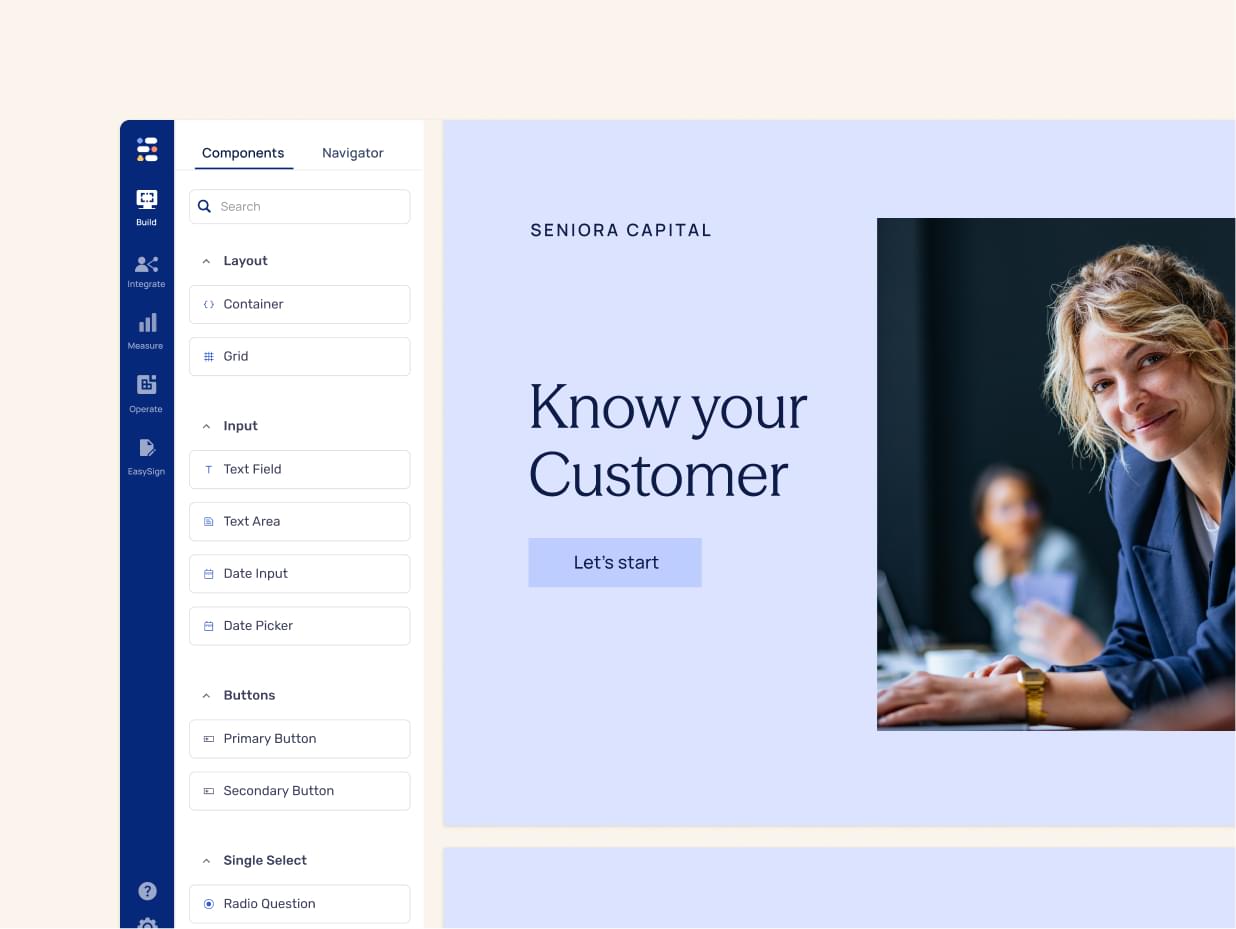
EasySend is more than a digital form builder.
It provides a complete customer interaction platform that helps insurers create personalized digital experiences across the policy lifecycle.
A typical policy application Journey can include:
- Guided customer journeys
- Conditional logic
- Structured data models
- Real-time validation
- Secure document upload
- Dynamic Documents
- EasySign
- Multi-party workflows
- Automated reminders
- CRM and policy administration integrations
- Analytics
- Audit trails
Because EasySend works alongside existing insurance systems, insurers can modernize customer interactions without replacing core technology.
Traditional online forms vs. digital customer journeys
<markdown>
  | Capability | Traditional online form | Digital customer journey |
|------------|-------------------------|--------------------------|
| Personalized experience | Limited | ✓ |
| Conditional logic | Basic | Advanced |
| Real-time validation | Basic | Advanced |
| Prefilled customer data | Rare | ✓ |
| Document uploads | Basic | Integrated |
| Multi-party workflows | Rare | ✓ |
| Dynamic document generation | Usually unavailable | ✓ |
| Built-in eSignature | Often third-party | ✓ |
| CRM & PAS integrations | Basic | Deep integrations |
| Automated reminders | Limited | ✓ |
| Customer progress tracking | Limited | ✓ |
| Best for | Simple applications | End-to-end insurance processes |
</markdown>
Best practices for reducing policy abandonment
- Replace static PDFs with guided digital journeys.
- Ask only questions that are relevant to the applicant.
- Prefill customer data whenever possible.
- Validate information in real time.
- Allow customers to upload documents securely.
- Keep eSignatures within the same experience.
- Send automated reminders for incomplete applications.
- Make every application mobile-friendly.
- Offer Save and Continue functionality.
- Monitor analytics to identify where customers abandon the journey.
Frequently asked questions
What causes insurance policy applications to be abandoned?
The most common reasons include long forms, PDF-based applications, repeated data entry, poor mobile experiences, unclear document requirements, and slow manual processes.
What is a digital customer journey in insurance?
A digital customer journey is an interactive, guided experience that manages the complete customer process—from data collection and document uploads to approvals, signatures, and integrations with core insurance systems.
How do digital journeys improve completion rates?
Digital journeys reduce friction with conditional logic, prefilled data, real-time validation, automated reminders, mobile-friendly experiences, and built-in electronic signatures.
Are digital journeys better than online forms?
Yes. Online forms primarily collect information, while digital journeys orchestrate the entire insurance process, including workflows, document generation, approvals, signatures, and integrations.
Can EasySend integrate with existing insurance systems?
Yes. EasySend integrates with policy administration systems, CRM platforms, Guidewire, Duck Creek, Salesforce, document management systems, payment platforms, and other enterprise applications through APIs and webhooks.
How can insurers measure policy drop-off?
Track metrics such as application completion rate, drop-off by step, average completion time, document upload completion, signature completion, quote-to-policy conversion, and customer satisfaction. Monitoring these metrics helps identify bottlenecks and continuously optimize the customer experience.
FAQ

Forget forms. Create digital customer journeys.